

Subscribe to the MEDplus Telegram channel to read us in a convenient format
Modern Balanced Nutrition: Macronutrients, Calories, and Insulin Resistance

Every day, I see a direct connection between a person's daily diet and the development of dangerous metabolic and cardiovascular disorders.
Recently, during a family physicians’ webinar held by the Medicine Evolution Association, my esteemed co-speaker—Candidate of Medical Sciences, endocrinologist Olena Dobrovynska—and I discussed this issue in depth. The main takeaway from that meeting: today, it is no longer enough for a doctor to simply tell a patient to “eat healthy.” We need a clear algorithm for evaluating diet and practical tools to help patients make real changes.
Many people see dietary changes as a temporary diet, but they are a fundamental physiological necessity. To understand what balanced nutrition truly is, I propose looking at it as a comprehensive, long-term system rather than a short-term campaign.
“Balanced nutrition is a pattern of human dietary behavior aimed at replenishing the expended proteins, fats, carbohydrates, fiber, vitamins, and macro- and micronutrients that the body utilizes for homeostasis, physical, and mental activity.”
For a practicing physician, this holds very concrete significance. We should not evaluate an isolated food product or establish rigid prohibitions; instead, we must analyze the entire dietary behavior system. Only this way can we ensure the body receives the nutritional support it needs for an active daily life and disease prevention.
A myth is deeply rooted in society that healthy eating necessarily consists of a list of harsh restrictions and a constant feeling of hunger. The modern evidence-based dietetic approach differs from simplistic recommendations such as “cut out sweets,” “do not eat after 6 PM,” or “just reduce your portions.” In reality, a healthy individual can eat virtually anything without self-imposed prohibitions (apart from added sugar), as long as it aligns with nutrient balance.
In dietary structure, the primary roles are played by:
- product quality, where whole foods must form the foundation;
- regularity of meals and fostering a culture of eating;
- adequate energy value;
- balance of macronutrients (proteins, fats, and carbohydrates);
- presence of fiber, which acts like a sponge in the intestines and ensures healthy stool;
- micro- and macronutrients that support metabolic health;
- the individual needs of a specific patient.

Patients frequently believe that daily calorie intake is the sole indicator of success. However, caloric density is merely one aspect. Excess weight undoubtedly results from consuming more energy than is expended. Yet the quality of that energy matters. Factors that influence energy needs include age, sex, body weight, height, physical activity, and existing metabolic disorders.
For a physician, giving the patient actionable guidance is crucial. I recommend starting with a dietary audit—using fitness apps with the target set to “maintenance.” This allows an individual to analyze their actual caloric intake without stress and identify errors, such as overeating at lunch. However, calculating the body’s calorie requirements should not be viewed in isolation from food composition and the clinical context. Energy balance must be supported by nutrient-dense foods.
Moving on to the most important step: the patient must learn how to calculate their macronutrients (proteins, fats, and carbohydrates) independently, as pre-packaged weight-loss marathons foster dysfunctional eating behaviors. A practical approach is to precisely assess the protein, fat, and carbohydrate ratio. Identical caloric values across two different diets do not imply identical nutritional value.
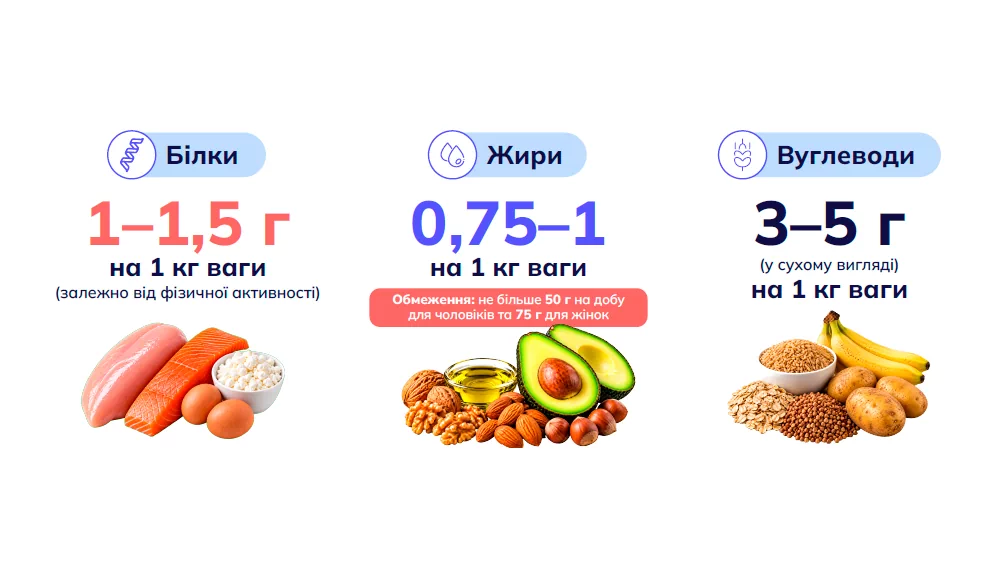
According to my concept, the baseline daily standards are:
- Proteins: 1–1.5 g per 1 kg of body weight. They are an essential component of every meal to support tissue recovery. Remember that meat or fish contains only about 20% pure protein, and we do not include plant-based protein in this calculation at all.
- Fats: 0.75–1 g per 1 kg of body weight. This is the most energy-dense form of food (9 kcal/g), so animal fats should not be avoided.
- Carbohydrates: 3–5 g per 1 kg of body weight in dry form.
Special attention must be paid to carbohydrate quality. The most critical rule is to choose complex (slow) carbohydrates that provide steady energy without sharp blood sugar spikes. They should make up at least 2/3 of the daily caloric intake. Simple carbohydrates, on the contrary, provide only short-lived satiety. This is particularly crucial when working with patients who have impaired carbohydrate metabolism, where fiber and slow carbs become the cornerstone of therapy.
The logic behind dietary design is structured as follows: food selection → portion sizes → macronutrients → caloric value → diversity → alignment with human needs. I always emphasize that there is no universal “one-size-fits-all healthy menu.” The diet must be individualized as much as possible. To illustrate this structure, you can download a meal plan to use as a baseline guide. It is a guide that helps clarify the essence of balanced nutrition and provides examples of how to organize such eating simply and quickly.

I am convinced that added sugar is a key pathogenetic trigger for systemic metabolic disorders. When a patient develops insulin resistance, nutrition becomes the primary instrument for correcting metabolic health and restoring insulin sensitivity. Dietary recommendations must consider the patient’s overall metabolic profile, glycemic control, physical activity level, body weight, and concurrent risk factors.
However, effective treatment is possible only through a team-based approach. Collaboration among a family physician, endocrinologist, dietitian, and other specialists makes it possible to build comprehensive nutritional support that delivers real results. Every patient needs to learn how to use a “meal builder”: assembling a plate with protein, complex carbohydrates, vegetables, and spices without added sugar.

My central conviction, which I share regularly through my blog: a doctor’s task is not to prescribe a temporary diet, but to help the patient integrate balanced nutrition into their everyday life.
To make this process successful, I suggest a clear sequence of actions for colleagues in outpatient practice:
- Assess current dietary behavior (conduct a nutritional audit).
- Determine actual energy needs.
- Evaluate the composition of the habitual diet.
- Analyze macronutrients.
- Identify metabolic risks.
- Formulate individual recommendations and explain the underlying mechanics to the patient.
- Monitor adherence to recommendations over time.
Modern nutritional science in medicine is not a collection of universal weight-loss marathons or temporary restrictions. It is a nuanced, evidence-based instrument for working with a specific individual. No diet can deliver long-term results without harming health. That is why a physician must have not only theoretical knowledge, but also a clear, practical algorithm for daily patient care. Remember: balance in nutrition is always balance in life.

A blog on MEDplus is an author’s work that reflects only the author's personal opinion. The text does not claim to be fully objective or provide a comprehensive view of the topic but represents the expert’s subjective perspective within the framework of evidence-based medicine.
The MEDplus editorial team is not responsible for the accuracy or interpretation of the information presented. The platform serves as a space for professional knowledge exchange and experience sharing.
Do you like the article?
Ratings: 0